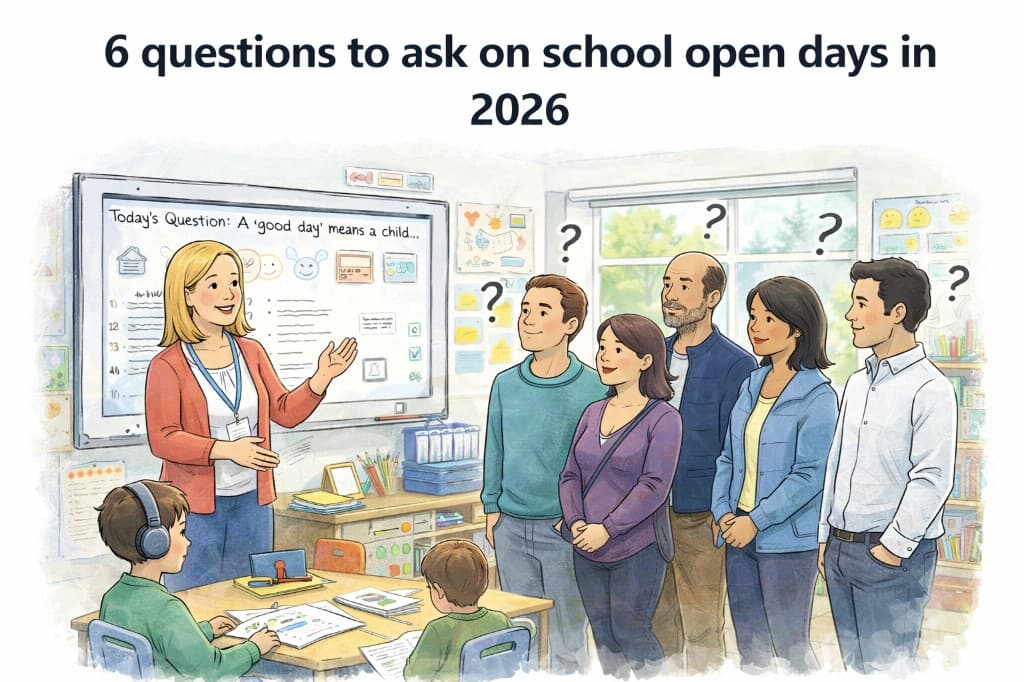
School open days can be brilliant - and also slightly misleading. You see the best classrooms, the tidiest corridors, and the most polished version of the school.
That doesn't mean you can't get real insight. You just need questions that push beyond the brochure and into the day-to-day reality: routines, behaviour, learning support and communication.
Below are six questions that work particularly well for UK parents choosing state primaries, juniors or secondaries in 2026.
1) "What does a good day look like for a child like mine?"
This sounds simple, but it forces specificity. If your child is quiet, sensitive, very academic, anxious, sporty, chatty, easily distracted - say so. Then ask how a normal day feels for that child.
Good answers sound like
- ●A clear routine (arrival, transitions, break, lunch, lessons)
- ●How teachers keep children on track without constant telling-off
- ●Practical support when a child struggles socially or emotionally
Less helpful answers sound like
- ●"We support everyone" (with no examples)
- ●"You'll be absolutely fine" (also no examples)
2) "What are the most common behaviour issues you see, and what happens in the first five minutes?"
Every school says behaviour is good. What matters is the system: what staff do in the moment, and what happens afterwards.
You're listening for calm routines and consistency - not perfection.
Good answers
- ●Clear steps: reminder → reset → consequence → restore
- ●How they follow up with parents
- ●How they support children who repeatedly struggle
Red flags
- ●"We don't really have behaviour issues"
- ●Vague phrases with no process ("high expectations" without any detail)
3) "How do you spot a child who is quietly struggling - and how quickly do you act?"
Plenty of children don't misbehave when they're struggling. They withdraw. Or they coast. Or they stop enjoying school.
Ask how the school identifies and responds.
Good answers
- ●Regular check-ins and teacher observation, not just tests
- ●"If we notice X, we do Y within Z weeks"
- ●Specific interventions (reading support, small groups, pastoral check-ins)
Red flags
- ●Support that depends on a single brilliant person
- ●Unclear timelines ("we keep an eye on it")
4) "What does SEND support look like in a normal classroom?"
Even if your child has no SEND diagnosis, this question tells you a lot about culture and teaching quality.
You want to hear what happens in real lessons, not just paperwork.
Good answers
- ●Practical classroom adaptations (instructions, scaffolding, sensory supports, routines)
- ●How the SENDCo works with teachers
- ●A graduated response (start with adjustments, then structured interventions)
Red flags
- ●"Our SENDCo is great" (and nothing else)
- ●Support that sounds like removing children from lessons as the default
5) "How do you communicate with parents, and what happens when something goes wrong?"
In real life, the difference between a smooth year and a frustrating year is often communication.
Ask: how often teachers proactively share information, who to contact for learning concerns vs wellbeing concerns, and what the escalation path is if you're worried.
Good answers
- ●Clear channels, response expectations and named roles
- ●A culture of early communication rather than defensive silence
Red flags
- ●"Email the office" with no clarity who owns issues
- ●Blame-y language about "difficult parents"
6) "If you were me, what would you want to verify before choosing this school?"
This flips the dynamic. Strong schools usually welcome verification and give sensible suggestions.
Good answers
- ●"Visit on a normal morning, not just open day"
- ●"Ask about transitions, reading, behaviour routines, support"
- ●"Look at how children move around the school"
Red flags
- ●Discouraging extra visits
- ●Controlling what you can see
A simple trick: ask two people the same question
Ask a senior leader and a classroom teacher the same question about behaviour or support. If the answers match, that's a good sign the school has consistent systems (not just good marketing).
Want to shortlist faster?
Open days are essential, but they're most useful when you already know what to focus on. Our reports pull together Ofsted, attendance, exclusions, outcomes, Parent View and admissions context so you can arrive at visits with the right questions - and feel confident you're comparing schools fairly.
Get your School Shortlist reportRelated articles
School open day checklist: what to look for (and how to compare schools fairly)
A practical open day checklist - what to observe, what to ask, and how to take notes so you can compare schools without second-guessing.
8–10 min readHow to interpret Ofsted, Parent View and DfE data (without overthinking it)
A parent-friendly guide to reading Ofsted reports, Parent View and DfE data - what's meaningful and what's noise.
9–11 min readUK school admissions explained (Primary, Junior and Secondary) - in plain English
Admissions without jargon: how places are allocated, what differs by school type, and what you should check.
10–12 min read